
The celebration showcased world-leading quantum research from across the London Centre for Nanotechnology
World Quantum Day is celebrated annually on 14 April. This date is chosen because the first three digits of Planck’s constant, the fundamental constant for quantum, are 4.14 x 10^-15 eVs.
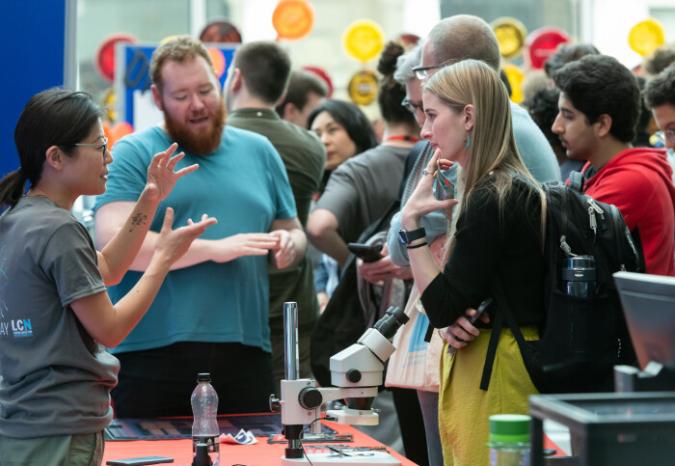
Hundreds of people attended the celebration at Imperial College London to learn about the cutting-edge quantum research across the Imperial Centre for Quantum Engineering, Science and Technology and the London Centre for Nanotechnology, a cross-institution initiative that includes researchers from Imperial, UCL and King’s College London.
Professor Sandrine Heutz, Co-Director of the London Centre for Nanotechnology and Head of the Department of Materials at Imperial, commented:
“We were incredibly pleased to see so many engaged attendees at our first World Quantum Day celebration. It was a fantastic way to convey quantum concepts in an accessible and relatable manner, which is crucial to the development and adoption of a quantum-enabled future.”
Exploring the World of Quantum
The event featured talks, live demos, and interactive opportunities to increase the awareness of quantum research a wider audience, inspire a new generation of quantum scientists and demonstrate the impact quantum technologies can have on our everyday lives.
A few highlights included an talks from: Professor Sandrine Heutz, (Co-Director of the London Centre for Nanotechnology and Head of the Department of Materials), Dr James Millen (Experimental quantum scientist and Director of King’s Quantum at King’s College London), Daisy Shearer (Lead for Quantum Education and Outreach at the National Quantum Computing Centre) and Tom Newby (Head of the UK Office for Quantum Technologies, Department for Science, Innovation and Technology). Their talks explored the fundamentals of quantum science, how quantum technologies will transform societies and economies, and the UK’s National Quantum Strategy.
Live demonstrations highlighted the breadth of quantum research, showcasing the potential of quantum sensors and computers, how quantum technologies could optimise life in modern cities, the science behind powering lasers and research in the unique Imperial SPIN-Lab, which investigates the properties of materials for quantum.
There were also many opportunities for collaborative discovery, with students from across the LCN (led by the Imperial Quantum Technology Society) crowd-sourcing a jargon-free dictionary. Their discussion helped attendees define terms like ‘quantum computer’, ‘engagement’, ‘qubit’, ‘tunnelling’ and ‘wave-particle-duality’.
Lastly, attendees were invited to unwind with a quantum meditation and soundscape, accompanied by a unique composition generated using recordings from the LCN’s quantum labs.
Dr Jess Wade, who led the organisation of the event, commented: “Our Quantum Day celebrations definitely left the audience in an excited state!
Taking quantum physics out of the lab and into technologies that benefit society requires partnerships between scientists, engineers, policymakers and the public.
It’s an exciting time to be at Imperial – Quantum is at the heart of our new strategy and championed by our leadership. I can’t wait to see what scientific breakthroughs we’ve made across campus by Quantum Day 2025!”
Photo credit: Dave Guttridge
Soundscape Design: Megan Grace-Hughes, King’s College London
A version of the article first appeared in the Imperial website.