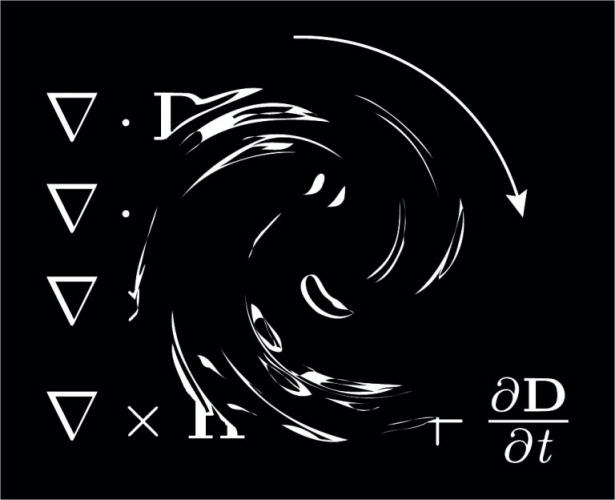

John Clerk Maxwell developed his famous Maxwell Equations whilst working at King’s College London in the late 19th Century. The Maxwell Equations are four equations which link the fundamental behaviour of electric and magnetic fields.
Electromagnetic fields and waves, including light, are essential in modern technologies providing internet, mobile phones, lasers. In the quest for ever smaller and energy-efficient devices, researchers study the interaction of electromagnetic waves with nanostructures.
As the spaces being studied are so small, often smaller than the wavelength of light or ‘sub-wavelength’, several new parameters of light waves become crucial, such as light polarisation, which define the spin of light.
Following in Maxwell’s footsteps, a team of LCN researchers at the Physics Department, King’s College London, in collaboration with Shenzhen University in China, have developed the set of equations for spin and momentum of the electromagnetic field, which are analogous to the Maxwell’s equations. This new set of equations allow a direct understanding of spin properties without the explicit knowledge of the electromagnetic field.
In analogy to renown effects in condensed matter physics, photonic quantum spin-Hall effect and photonic skyrmions require careful description of spin properties of light waves, which is possible with Maxwell’s equations, but the derivations are lengthy and cumbersome.
Using the newly developed equations, the team has now demonstrated the unconventional spin properties of the electromagnetic waves carrying orbital angular momentum, important for optical communications, quantum technologies, high-resolution imaging and many other fields.
The new equations offer a shortcut for describing the unconventional spin behaviour of the electromagnetic waves, and can be applied to describe also fluid, acoustic and gravitational waves.
Using this approach, it is very easy to see new, unexpected phenomena in the electromagnetic spin behaviour. For example, we predicted and experimentally observed dynamic behaviour of the transverse spin of guided waves arising due to spin-orbit coupling, which has completely different behaviour from the static transverse spin of evanescent plane waves.
Professor Anatoly Zayats, Head of Photonics & Nanotechnology Group, King’s College London
Transverse spin dynamics in structured electromagnetic guided waves is published in Proceedings of the National Academy of Sciences of the United States of America.