
Random forces usually have a destabilising effect. A tightrope walker would rather not experience gusts of wind, for example. There are, however, cases where random forces can stabilize a system in state that would otherwise be unstable. The essential ingredient is that the random forces or noise experienced by the system should depend upon the state of the system. For example, a multiply-jointed pendulum can be stabilised in an inverted configuration – without the need for feedback or control – if it is driven with random horizontal forces at its support. The spectrum of fluctuating forces experienced by the pendulum changes depending upon its orientation such that it is subtly corralled into the formerly unstable vertical orientation. This notion – when the driving force is periodic rather than noisy – was first described by Kapitza. For the multi-jointed pendulum, it is sometimes called an Indian rope trick, with reference to the famous conjuring trick.
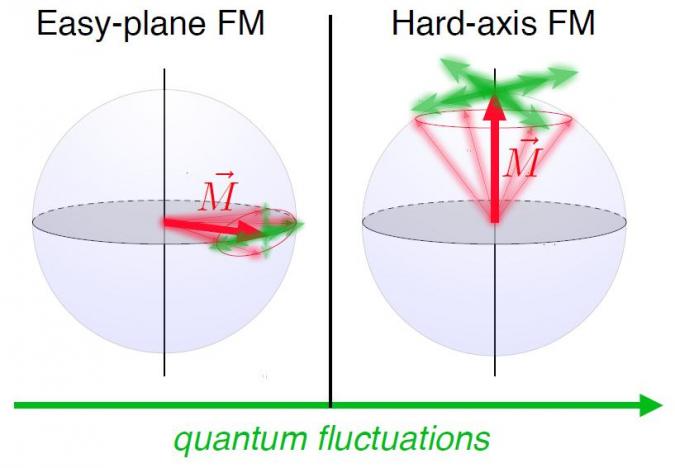
Fluctuations due to the intrinsic uncertainty of quantum mechanics can have a similar effect. At certain points in the phase diagram of a magnet- determined by values of pressure, magnetic field etc. – quantum fluctuations can become dramatically enhanced. These enhanced fluctuations can stabilise new phases.
Dr Frank Kruger, Dr Chris Pedder, and Prof. Andrew G. Green have uncovered perhaps the simplest example of such an effect in a quantum system. Certain ferromagnets when probed at temperatures above their ferromagnetic transition show a propensity to order along a particular direction. When the temperature is lowered, however, the magnetic ordering occurs perpendicular to this direction. A simple model shows that this may be due to the state-dependence of the quantum fluctuations favouring a direction of magnetic ordering that would otherwise have been unstable [Kruger, Pedder and Green, Physical review Letters 113, 147001 (2014)]. This is rather like the multi-jointed pendulum described above; by adopting an inverted configuration in the presence of fluctuations – the ferromagnet performs a quantum Indian rope trick!
The quantum order-by-disorder approach provides a conceptually simple way to describe these effects. The hope is that this understanding will ultimately help us to harness and control such effects of quantum fluctuations to produce material with properties of technological benefit.
Publication: Fluctuation-Driven Magnetic Hard-Axis Ordering in Metallic Ferromagnets, Physical Review Letters 113, 147001 (2014) DOI: 10.1103/PhysRevLett.113.147001