
News

Seeing polarons at a metal oxide surface

Polarons in metal oxides play a key role in processes such as catalysis, high temperature superconductivity, and dielectric breakdown in nanoscale electronics.  For this reason, numerous studies have been conducted on technologically relevant oxide materials in which charge carriers are believed to be self-trapped, forming polarons.

In this paper, we demonstrate that the excess electrons associated with oxygen vacancies at rutile TiO2(110) behave as small polarons.

Using scanning tunneling microscopy (STM) combined with density functional theory, we find that the electrons are symmetrically distributed around isolated vacancies at 78 K, but as the temperature is reduced, their distributions become increasingly asymmetric, confirming their polaronic nature.

By manipulating isolated vacancies with the STM tip, we also demonstrate that particular configurations of polarons are preferred for given locations of the vacancies, which we ascribe to residual electric field at the surface. Using the same tip pulses in STM, we also form a series of vacancy complexes, and manipulate the Ti ions around them, both of which change the associated polaronic distributions.

We therefore demonstrate that the configurations of polarons can be engineered, paving the way for the construction of conductive pathways relevant to resistive switching device.
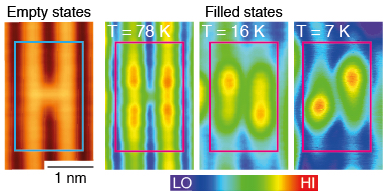
Figure: Representative STM images of isolated Ob-vacs on TiO2(110) recorded using positive (empty states) and negative (filled states) sample bias at different temperatures

Original article: Engineering Polarons at a Metal Oxide Surface, Physical Review Letters, 2016
More news

Nano and Quantum tech meets dance floor: LCN celebrates 20th anniversary at Great Exhibition Road Festival 2026

Nano and Quantum tech meets dance floor: LCN celebrates 20th anniversary at Great Exhibition Road Festival 2026

The London Centre for Nanotechnology (LCN) brought cutting-edge science vividly to life at the Great Exhibition Road Festival on ... Find out more

LCN Researcher named 2026 Blavatnik Awards Laureate

LCN Researcher named 2026 Blavatnik Awards Laureate

Professor Maxie Roessler of Imperial College London’s Department of Chemistry has been named a Laureate of the 2026 Blavatnik Awards ... Find out more

LCN co-director receives 2026 SPIE Directors’ Award

LCN co-director receives 2026 SPIE Directors’ Award

LCN co-director Professor Anatoly Zayats has been awarded the 2026 SPIE Directors’ Award.  SPIE, the International Society for Optics ... Find out more

ARTISTS

Andy Gomez

Chuting Lee

Clare Jarrett

Eveleigh—Evans

Ian Dawson

Jennifer Moore

Sandy Layton

Megan Grace-Hughes

SCIENTISTS

Cecilia Mattevi

Camille Petit

Oriol Gavalda Diaz

Sandrine Heutz

Jess Wade

Joseph Cotter

Shelly Conroy & Rahil Haria

Ryan Bower, Bruno Rente,  

Equipment & Facilities

EDUCATION

Training

Loading...
Privacy Overview

This website uses cookies so that we can provide you with the best user experience possible. Cookie information is stored in your browser and performs functions such as recognising you when you return to our website and helping our team to understand which sections of the website you find most interesting and useful.