
The latest issue of Photonics Focus shines a spotlight on optical skyrmions, intricate topological structures formed by light fields that promise to transform the future of photonics.
LCN researchers in the Department of Physics at King’s are at the forefront of this exciting research. Professor Anatoly Zayats‘ group is pioneering work on how to generate and control these nanoscale light patterns. By merging fundamental physics with practical innovation, they are paving the way for energy-efficient, next-generation optical devices.
What Are Optical Skyrmions?
Originally studied in magnetic systems, skyrmions are topological configurations, patterns that remain stable even when disturbed. In optics, these structures emerge when light fields are carefully engineered so that their polarisation and phase create a unique, swirling topology. Think of it as sculpting light into a nanoscale knot that does not easily unravel.
Why Does This Matter?
Optical skyrmions introduce topology into optics, creating structures that are remarkably stable and versatile. This opens up opportunities for breakthroughs in:
- Quantum Technologies: Secure communication and quantum computing could leverage these robust light structures.
- High-Resolution Imaging: Skyrmions can enhance imaging systems, pushing the boundaries of detail and clarity.
- Optical Data Processing: Encoding information in topological patterns of light offers new ways to store and transmit data efficiently.
A New and Exciting Frontier
This concept has only emerged in recent years, and researchers are still uncovering its full potential. With only a handful of research groups worldwide exploring this phenomenon, the field is rapidly evolving, making it an exciting time for scientists and engineers to push the boundaries of what light can do.
The Big Picture
Optical skyrmions represent more than a scientific curiosity; they are a glimpse into the future of light-based technologies. As photonics continues to intersect with quantum science and nanotechnology, these topological structures could become the building blocks of tomorrow’s communication and computing systems.
Read the full feature in SPIE’s Photonics Focus: The Optical Skyrmion: A Photonic Playground for Physicists.
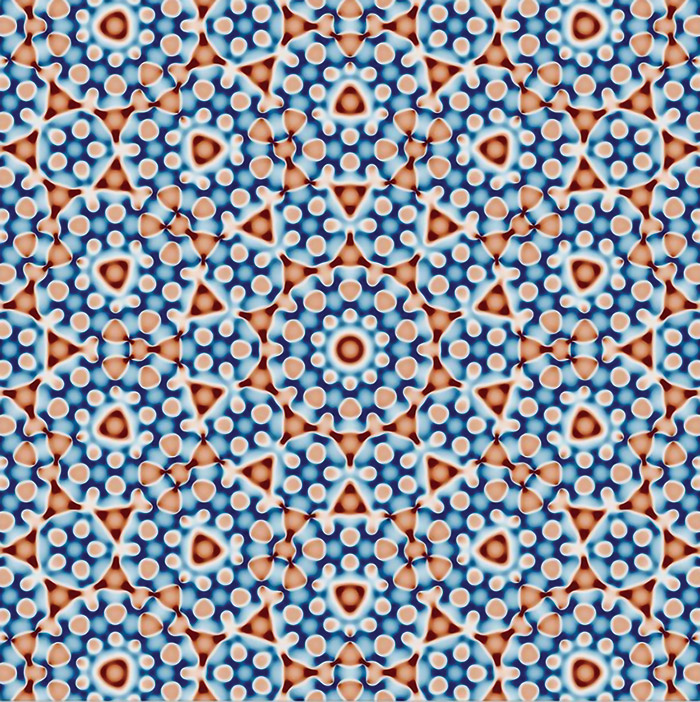
Image: A five-fold quasicrystal formed by skyrmions and merons – Photo credit: Dr Henry Putley.