
Creating practical solid-state, quantum computers that operate at room-temperature is a challenging task. This is because stored information is readily destroyed by thermal noise. A signature of a physical system’s ability to function as a quantum computer is the observation of quantum Rabi oscillations since they represent the possibility of ‘reading’ and ‘writing’ quantum information. To-date, these have been observed reliably and consistently only at milli-Kelvin temperatures.
In a project supported by the EPSRC, an LCN team of investigators at both the Imperial College and UCL sites have used an organic molecular crystal, a dielectric resonator and pulses of laser light to produce pronounced quantum Rabi oscillations at microwave frequencies, lasting up to 10 microseconds at room-temperature.
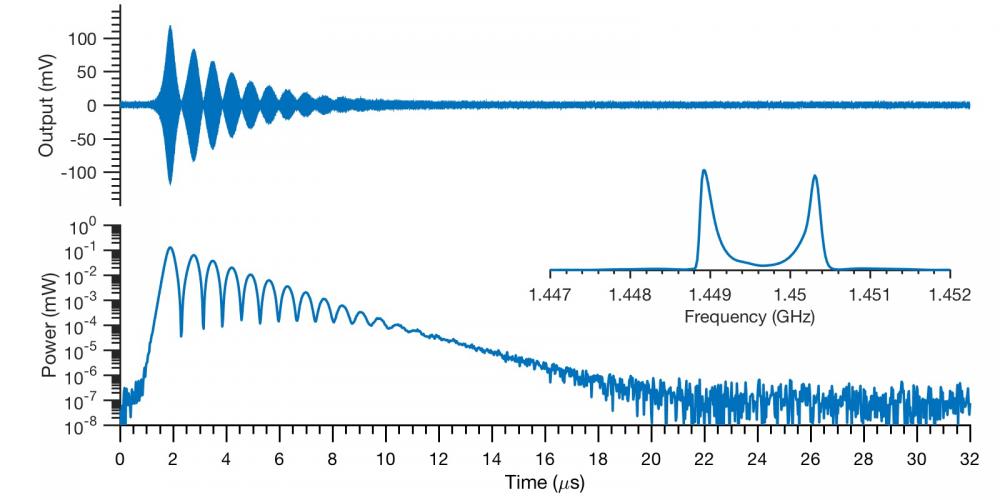
Figure: The microwave output from a single crystal of a terphenyl doped with pentacene held in a dielectric resonator as a function of time following pulsed laser excitation is depicted in the upper panel. The oscillations are due to the strong coupling between the collective spin ensemble and the photons in the high Purcell factor resonator. This results in the microwave frequency being split, as clearly seen in the Fourier transform of the signal depicted in the insert. The lower panel shows the microwave power output as a function of time on a logarithmic y-axis
Lead author, Dr Jonathan Breeze of Imperial College commented: “This discovery paves the way for room-temperature quantum information processing devices such as spin memories and quantum-enhanced technologies for metrology, sensing, communications and ultimately – quantum computing.”
Last author, Prof. Chris Kay added: “This serendipitous and exciting discovery once again shows how blue skies research can lead to remarkable advances in scientific knowledge.”
Link to publication in npj Quantum Information: Room-temperature cavity quantum electrodynamics with strongly coupled Dicke states