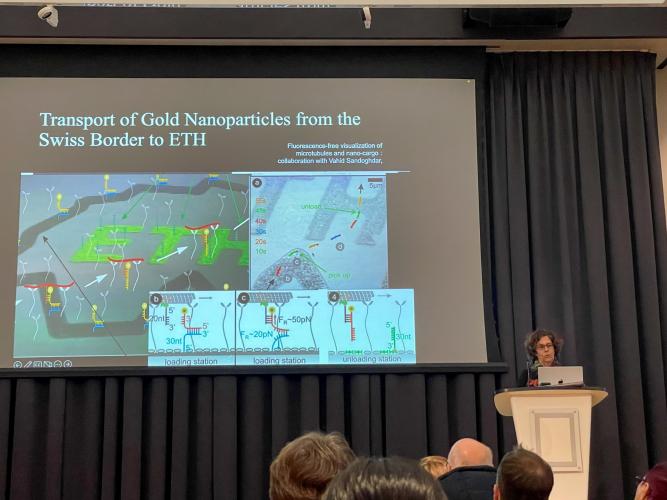

The Department of Physics at King’s College London recently hosted its annual Wheatstone Lecture, featuring guest lecturer Professor Viola Vogel from UTH Zurich. The lecture, “Why the Mechanical Design of Proteins Matters: From the Discovery of Physical Principles towards the Clinic,” explored the rapidly expanding field of mechanobiology, an emerging multidisciplinary field that investigates how physical forces and changes in the mechanical properties of cells and tissues, contribute to biological processes, including how cells develop, differentiate, degenerate and cause diseases.
King’s is home to a number of interdisciplinary London Centre for Nanotechnology researchers working in the field and is at the forefront of training the next generation of scientists with its unique Leverhulme Trust Mechanics of Life Doctoral Scholarships Programme, run by Professor Sergi Garcia-Manyes and Dr Katelyn Spillane, and the Centre for the Physical Science of Life, led by Professor Sergi Garcia-Manyes and Professor Paula Booth, which realises the transformative power of physical science in advancing understanding of the fundamental mechanisms underlying living systems across scales.
The Wheatstone Lecture has been hosted by the Department of Physics since 2013. Sir Charles Wheatstone FRS (1802-75) was a Professor of Experimental Philosophy at King’s and was the first Professor in the Department from 1834 until his death in 1875. A polymath and self-taught son of a London-based musical instrument maker, Wheatstone conducted early experiments into acoustics and the transmission of sound. His greatest achievement was the development of the electric telegraph, which revolutionised communications in the nineteenth century.
In her lecture, Professor Vogel challenged the traditional assumption that each protein has a unique structure that determines its function. She explained that our understanding of biology is limited because only the equilibrium structures of proteins have typically been resolved at high resolution. To fully understand protein and cellular function, we need to consider how proteins change and react when they are exposed to mechanical forces. It is an important challenge because mechanical forces affect the non-equilibrium properties of many biological processes defining life.
Professor Vogel emphasised the importance of the mechanical design of proteins and how protein stretching is exploited by cells to sense and respond to mechanical stimuli. She highlighted the challenges facing translational research in this field, such as the lack of nanoscale sensors to probe forces or tissue fibre tensions in healthy versus diseased organs. Vogel’s research aims to bridge the gap between understanding mechanobiology at the single-cell level and applying these principles in tissues, real organs and eventually in the clinic. Understanding how mechanical forces can switch the structure-function relationships of the underpinning proteins to regulate cell signalling is essential to establish the fundamental principles of mechanobiology.