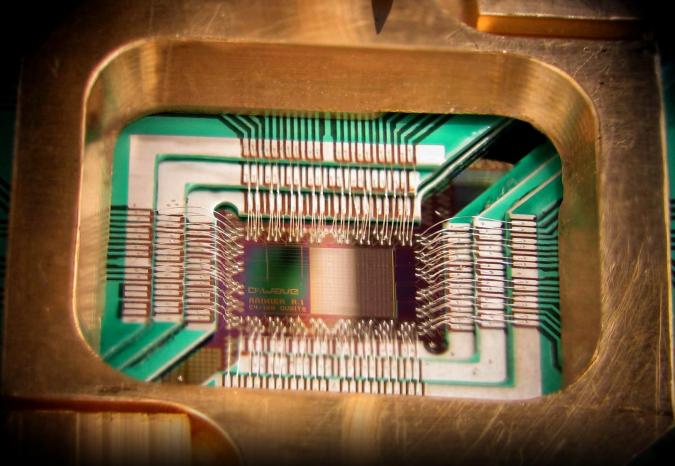

The Intelligence Advanced Research Projects Activity (IARPA), which sits within the Office of the Director of National Intelligence (ODNI), has just announced that it has embarked on a long-term research effort, involving a multi-institutional collaboration including LCN academics, to develop special-purpose algorithms and hardware that harness quantum effects to surpass conventional computing. Practical applications include more rapid training of machine learning algorithms, circuit fault diagnostics on larger circuits than possible today, and faster optimal scheduling of multiple machines on multiple tasks.
IARPA invests in high-risk, high-payoff research programs to tackle some of the most difficult challenges of the agencies and disciplines in the Intelligence Community.
Through a competitive Broad Agency Announcement process, IARPA has awarded a research contract in support of the Quantum Enhanced Optimization (QEO) program to the international team led by the University of Southern California. As well as University College London, the California Institute of Technology, Harvard University, Massachusetts Institute of Technology, University of California at Berkley, Saarland University, University of Waterloo, Tokyo Institute of Technology, Lockheed Martin and Northrup Grumman are key collaborators. Participants providing validation include NASA Ames Research Centre and Texas A&M, and those providing government-furnished hardware and test bed capabilities include MIT Lincoln Laboratory and MIT.
“The goal of the QEO program is a design for quantum annealers that provides a 10,000-fold increase in speed on hard optimization problems, which improves at larger and larger problem sizes when compared to conventional computing methods,” said Dr Karl Roenigk, QEO program manager at IARPA. If successful, technology developed under this program will provide a plausible path to performance beyond what is possible with today’s computers.
Paul Warburton, the head of the UCL research team, said “This is a great opportunity to get involved in a state-of-the-art project which potentially has the capability to transform the way we solve the hardest computational problems. We want to get to grips with the true power of quantum annealing using highly coherent superconducting devices.”
The likes of Professor Warburton’s research impacts on a growing number of companies are already experimenting with quantum computing to push their businesses forward, including Volkswagon, as discussed in the Wall Street Journal.
Additional information on IARPA and its research may be found on https://www.iarpa.gov.
Original source: ODNI