
Two students in the Department of Materials, Imperial College London, were part of winning teams at recent quantum computing hackathons.
QHack 2023, one of the largest quantum computing hackathons in the world, was held online between 13 and 28 February 2023.
Louis Chen and Felix Xu, research postgraduates in the Department of Materials attended the hackathon and joined a team with Henry Makhanov from UT Austin.
The team tackled a project named ‘Using Quantum-Enhanced Support Vector Machines (QSVM) and Quantum Convolutional Neural Nets (QCNN) for Stellar Classification,’ which explored the application of cutting-edge quantum computing techniques for classifying stars based on their spectral characteristics.
By leveraging QSVM and Q-CNN, the team aimed to improve the accuracy and efficiency of traditional stellar classification methods. The team’s research sought to advance our understanding of celestial objects and contribute to the broader field of astrophysics. The team was awarded second place, with each student winning a grand prize of an Nvidia Geforce RTX 3090s GPU.
Solving high-dimensional problems
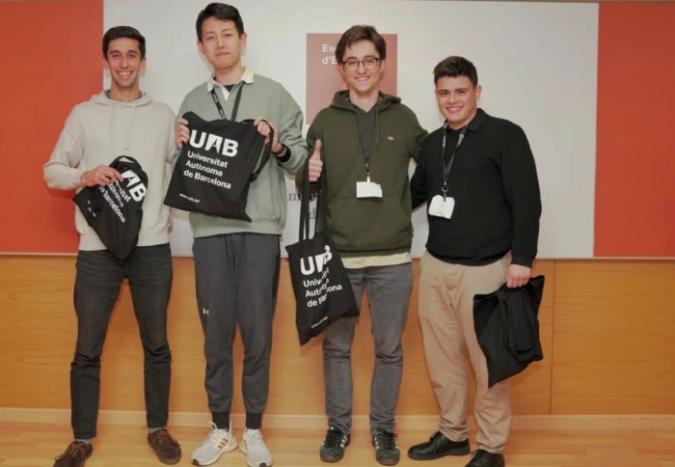
The Qiskit Hackathon was held in Barcelona on 1 and 2 April 2023.
Felix Xu entered the hackathon and was teamed with two students from the University of Barcelona, Adrià Blanco Culla and Pau Torrente Badia.
During the competition, teams had 24 hours to develop solutions to various issues in the field of quantum computing and present them to a panel of judges. The challenges were organised by renowned experts from IBM Quantum, ICFO, Moody’s, and the Barcelona Supercomputing Center.
Felix’s team successfully tackled Moody’s challenge by pricing a European call option with the Black-Scholes model in quantum computing. Their approach has the potential to solve very high-dimensional problems that classical computers cannot handle. As a result of their achievement, they were awarded first prize in the Moody’s challenge.