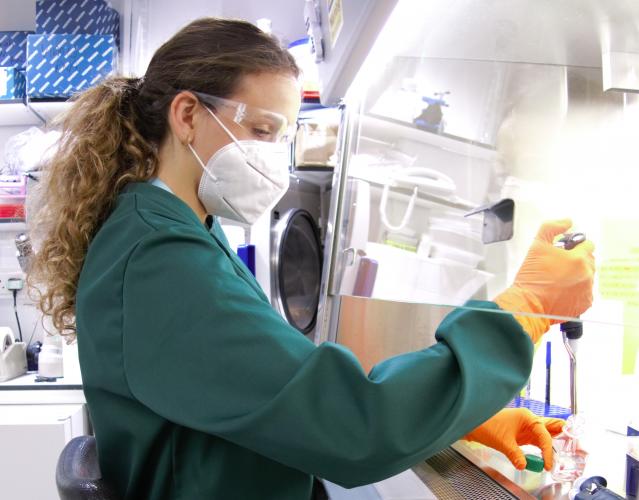

In mid-March, when the UK went into lockdown, a small group of researchers were given special access to i-sense labs in London, under modified safety measures. They were tasked with the important job of working collaboratively to develop point-of-care diagnostic tests for COVID-19.
The worldwide shortage in qPCR instruments and reagents has considerably slowed down the response to the COVID-19 pandemic and hindered the ‘test, trace, isolate’ strategy that was urged by the World Health Organization. This inspired PhD student Dounia Cherkaoui in Prof Rachel McKendry’s i-sense lab based at the London Centre for Nanotechnology (LCN), UCL to investigate alternative testing assays for the new virus. Meanwhile, Dr Ben Miller a post-doc in the group has been printing different SAR-CoV-2 antibodies on lateral flow strips for incorporation into the assay being developed by Prof Molly Stevens’ lab at Imperial College London; as well as working on improving the sensitivity of lateral flow antigen testing with both existing and novel nanoparticle technologies.
In the Stevens’ lab at Imperial, the multi-disciplinary translational team led by Dr Paresh Parmar and coordinated by Dr Marta Broto Aviles have been working alongside over 25 researchers from the group to assist the efforts in the lab and remotely. The team have been adapting existing i-sense diagnostic technologies for use in the COVID-19 response. Several ongoing projects include ultrasensitive lateral flow-based assays and the development of a rapid, isothermal and ultrasensitive platform to detect the virus.
Dr Leah Frenette from the Stevens group has been working on optimising the technology for its final format including nanoparticle processing, device format and assembly, and signal amplification. The ultrasensitive test being developed will dramatically reduce the analysis time of a viral test from one day in a centralised laboratory to 15 minutes anywhere. The team hopes to develop a cheaper, more accessible and more accurate diagnostic test compared to those already available.
Outside of lab-based research, i-sense members have been working on digital technologies for surveillance of the outbreak. Dr Bill Lampos and Prof Ingemar Cox at UCL Computer Science have developed machine learning models that use Google search data to understand the prevalence of the disease in England. The outcomes of this work are sent to Public Health England on a weekly basis.
This story first appeared on the i-sense website.