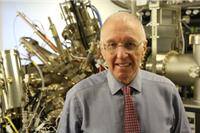

A collaborative project involving LCN Professor, Sir Michael Pepper, along with Dr Maksym Myronov (University of Warwick), Dr Stuart Holmes (Toshiba Research Europe, Cambridge Research Laboratory), Mr Yilmaz Gul and Dr Sanjeev Kumar, has shown that holes (the absence of an electron) can behave as if they had a fractional charge of 1/4; and 1/2; of the normal value which is the same as an electron.
In 1982 research workers at Bell Laboratories discovered that in two dimensions, and in the presence of strong magnetic fields and low temperatures, electrons could behave as if they had a fractional charge. They received the 1998 Nobel Prize for Physics for this discovery. In the current project, when the Warwick-Toshiba-UCL group initially confined the holes in strained epitaxial Germanium into a one-dimensional nanowire and then let them move apart, they found that the holes spontaneously organise themselves collectively and behave as if they had a charge of 1/2; and 1/4; of the normal value. This entirely unanticipated development has implications as the 1/4; charge, which has never been seen on its own, may form the basis of an emerging quantum computer technology.
Germanium is fully compatible with silicon, and the two elements can be integrated using modern semiconductor technologies. The fact that this phenomenon occurs in the absence of a magnetic field enables control circuitry to be installed on a silicon chip so allowing the development of an integrated quantum computer on a single silicon chip. In addition, the fact that the effect occurs spontaneously opens the door to tailoring the confinement of both electrons and holes in a controlled manner to attempt to control the value of the effective charge of the current carrying species. This has important implications for a wide range of developments in information technology.
The research is published in the Journal of Physics Condensed Matter
Related links: