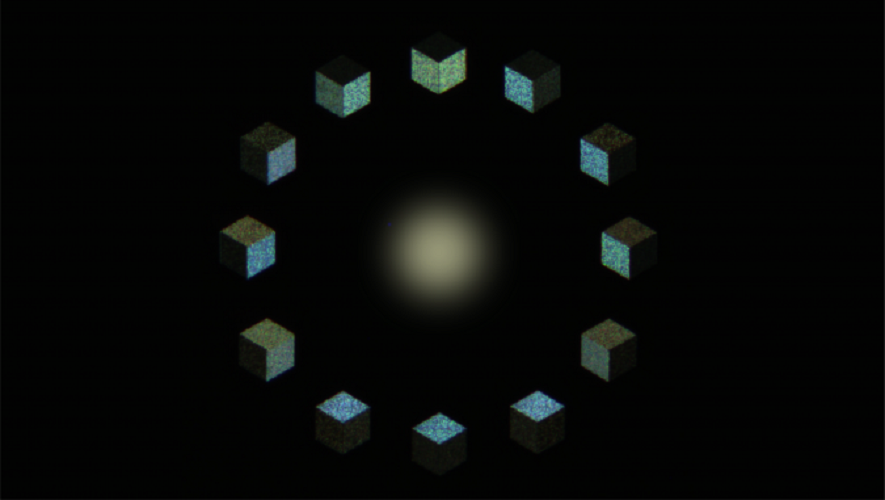

As part of an international collaboration with Southern University of Science and Technology in Shenzhen (China), LCN researchers at King’s College London have developed a novel way of generating colour 3D images using a reflective metasurface performing through the entire visible spectral range. Metasurfaces are 2D engineered materials typically made of subwavelength elements, which provide excellent control over the shaping of optical wavefronts via the manipulation of polarisation, phase and amplitude of the light. Unlike typical metasurface-based holography techniques, the developed method does not rely on interleaved nanostructures for wavelength multiplexing or wavelength-dependent off-axis illumination. Instead, the LCN researchers used specially-designed aluminium nanostructures to achieve a high metasurface efficiency across the visible spectrum, including the three main RGB colours. A combination of specular and diffuse reflections was employed to generate images of 2D structures with 3D effects. The true perception of a 3D object through shading effects is therefore ensured by an adequate change in the brightness of the reflected light from the flat metasurface in response to variations in the illumination or observation angle. In contrast with 3D holograms, this structure performs under incoherent illumination.
As a proof of concept, an image of a 3D cube was encoded onto the metasurface and illuminated with white light. The projected image displays shading effects changing according to the incident angle, therefore emulating the behaviour of a real 3D cube.
The lead author on the paper published in the journal Nano Letters, Dr Diane Roth said, “Metasurfaces are extremely versatile and have the potential to enable progress in many different areas of science, either introducing new functionalities or making existing technology smaller and lighter. The practical potential of our design is very interesting for a wide range of applications including security features for protection against counterfeiting but also artistic purposes.” More generally, the unique properties of diffuse metasurfaces could also have an impact on the development of new display technologies, flat light diffusers and integrated optical components.
Results from this international project have been published in the American Chemical Society journal Nano Letters.

Link to article in Nano Letters: 3D full-colour image projection based on reflective metasurfaces under incoherent illumination