
Single-walled carbon nanotubes have been used to encapsulate many types of materials since their discovery, but now other nanostructured phosphorus allotropes are attracting considerable attention as well.
The white phosphorus allotrope, which consists of tetrahedral P4 molecules has already shown to be made stable against the infamous spontaneous combustion with atmospheric oxygen. Recently, P4 was successfully encapsulated within supramolecular materials, which may be useful for mitigating dangerous phosphorus spills, or conversely, for controlled release of P4 into chemical reactions or for heat generation.
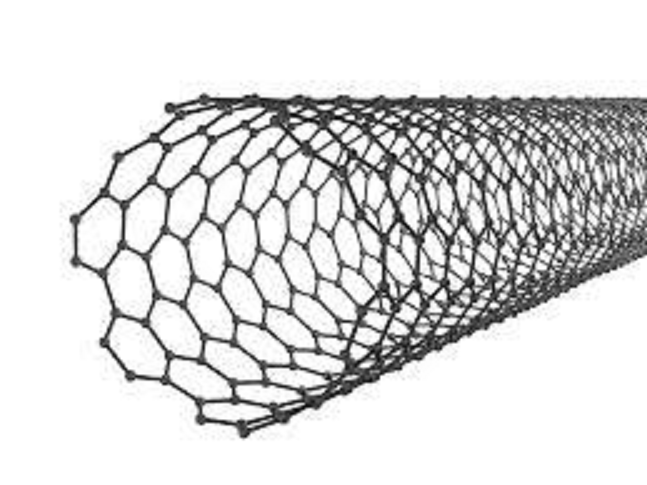
Single-wall carbon nanotubes (SWCNTs) offer an appealing potential encapsulation environment, with an inert, light-weight, cylindrical pore well-matched to the diameter of P4 molecules.
Researchers from the London Centre for Nanotechnology have successfully filled SWCNTs with white phosphorus (white phosphorus containing nanotube ‘peapods’) and explored the stability of the resulting structures. Working together with researchers from Cambridge, in addition to the experimental approaches the possible chain structures arising from phase transformations were evaluated using density functional theory (DFT). Calculations confirmed that the classic white phosphorus tetrahedra can react to form long chains, to create an allotrope half way between white and red phosphorus, which the team nicknamed ‘pink phosphorus‘.
As recently reported in Angewandte Chemie, the team has shown that the hollow cavity within single-walled carbon nanotubes can prevent the oxidation of white phosphorus and store up to 9 wt% of white phosphorus; more than any other system. Beautiful images obtained using the Titan microscope at Imperial College London, show the polymerisation of the white phosphorus tetrahedra occurring directly within the microscope.
This discovery could help determine the mechanism of the white-red phosphorus phase transition and potentially direct the identification and isolation of further new phases of phosphorus.
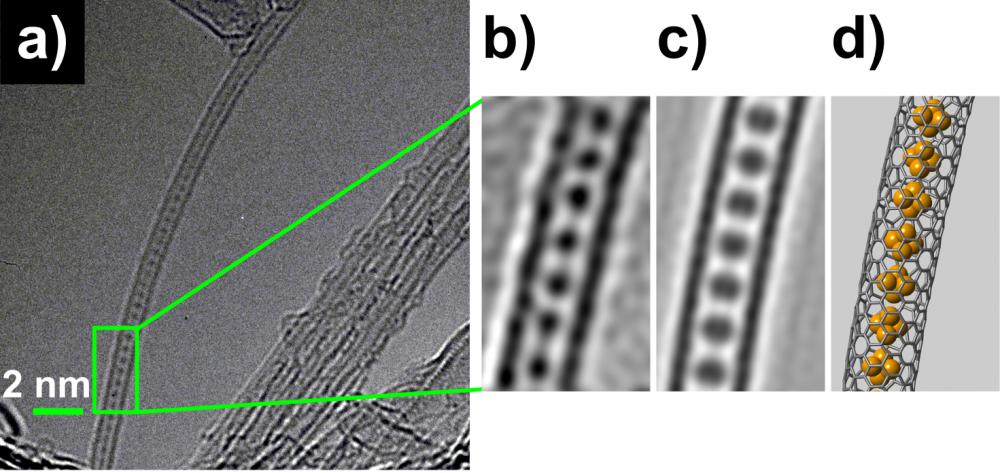
Figure: Putting the peas into the pod: SWCNTs filled with P4 molecules. (a) HRTEM image of a SWCNT filled with a string of P4 molecules. (b) Noise-filtered HRTEM image of the region highlighted in (a). (c) Simulated HRTEM image and (d) the corresponding atomic structure of P4 in SWCNT. Panels (b-d) are shown at the same scale
Related links: Full article in Angewandte Chemie