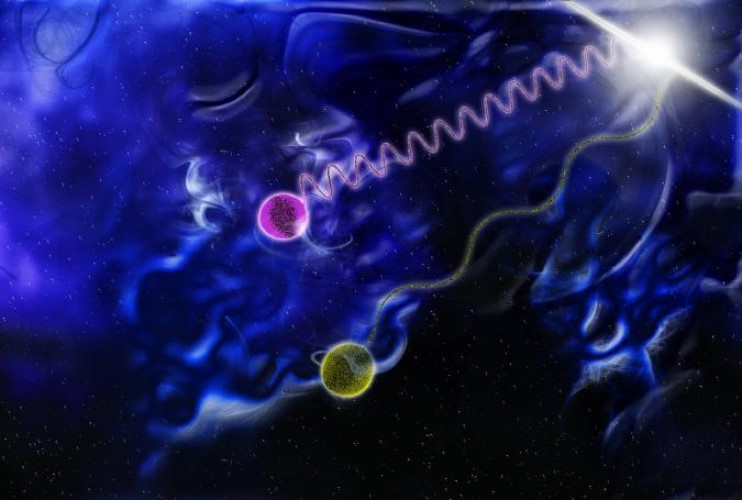

If particles of light (photons) are trapped in a two dimensional cavity, then they can couple electron-hole pairs present in semiconductors in the cavity. The resultant composite particles, which we call polaritons, flow like fluids do and can exhibit quantum behaviour on a macroscopic scale.
Superfluidity is a particularly spectacular macroscopic quantum phenomenon. First observed in liquid helium, superfluids flow with no viscosity and cannot rotate, except in the form of tiny tornado-like vortices, and can even spontaneously empty themselves from their container by climbing up the walls. These effects are well understood in systems in thermodynamic equilibrium, but polaritons never reach an equilibrium state as photons are constantly leaking out of the cavity and have to be replaced (pumping). It is unclear how to interpret the possibility of superfluidity in these systems.
Nevertheless, effects associated with superfluidity have been observed in experiments on polaritons, most notably the disappearance of viscosity as the polaritons pass an obstacle. In our paper we investigate whether the lack of viscosity in this case is a sign of a superfluid or of some other effect. To do this we calculate how the polaritons will respond to longitudinal and transverse forces, i.e. pushing and shearing. A true superfluid responds to longitudinal forces but does not rotate in a normal fashion and so does not respond to transverse forces.

Figure: Polaritons are quasiparticles formed when cavity photons, which are massive due to confinement in the z direction between two Bragg mirrors, interact strongly with excitons confined in a quantum well. Polaritons are free to move in the two-dimensional plane perpendicular to their confinement
LCN researchers have shown that polaritons that are pumped coherently (that is, where the photons are injected with a specific energy and momentum) cannot form superfluids. This is because while they do not respond to transverse forces they also do not respond to longitudinal ones – they form a new, unresponsive, rigid state of matter.
Therefore, experimental observations of coherently pumped polaritons flowing without viscosity are a sign of this rigid state, not superfluidity.