
A breakthrough has been achieved at the London Centre for Nanotechnology, where researchers from the Marie Curie initial training network (ITN) Organic Semiconductors for NIR Optoelectronics (OSNIRO), alongside collaborators from Advent Technologies in Greece and from the University of Wuppertal (Germany) have shown record external quantum efficiencies for diodes based on organic red/NIR oligomers free from heavy/toxic metals and combining electron-withdrawing (A) moieties together with electron-donating (D) ones, in a previously poorly studied “A-D-A” motif.
Near-infrared (NIR) organic light-emitting diodes (OLEDs) are a burgeoning and unusual class of devices with a host of promising optoelectronic properties. Their potential in the medical field (from photodynamic therapy, to pulsi-oxymetry, and intracellular imaging), telecommunication (e.g. optical communication), and defence areas (including night-vision devices and capillary mapping in identification systems) has commanded attention from both industry and academia. However, their luminescence efficiency is lower than achievable in the visible range, owing to the so-called “Energy gap law” according to which the non-radiative decay rate of an organic dye increases exponentially with reducing energy gap.
The international team have taken advantage of a recent breakthrough in the synthesis of a class of α,β-unfunctionalised boron-containg moieties (4,4-difluoro-4-bora-3a,4a-diaza-s-indacenes, or “BODIPYs” in short), that were symmetrically conjugated with oligothienyls in an unexpectedly stable form, and then incorporated in a wider gap polyfluorene matrix. This enabled the group to demonstrate OLEDs with emission peaking at 720nm and external quantum efficiencies up to 1.1%, the highest value achieved so far by a NIR-OLED not containing toxic/heavy metals (thus also suitable for medical and potentially biocompatible applications).
Their work demonstrates for the first time the promise of A-D-A type dyes for NIR OLEDs applications thereby paving the way for further optimisation.
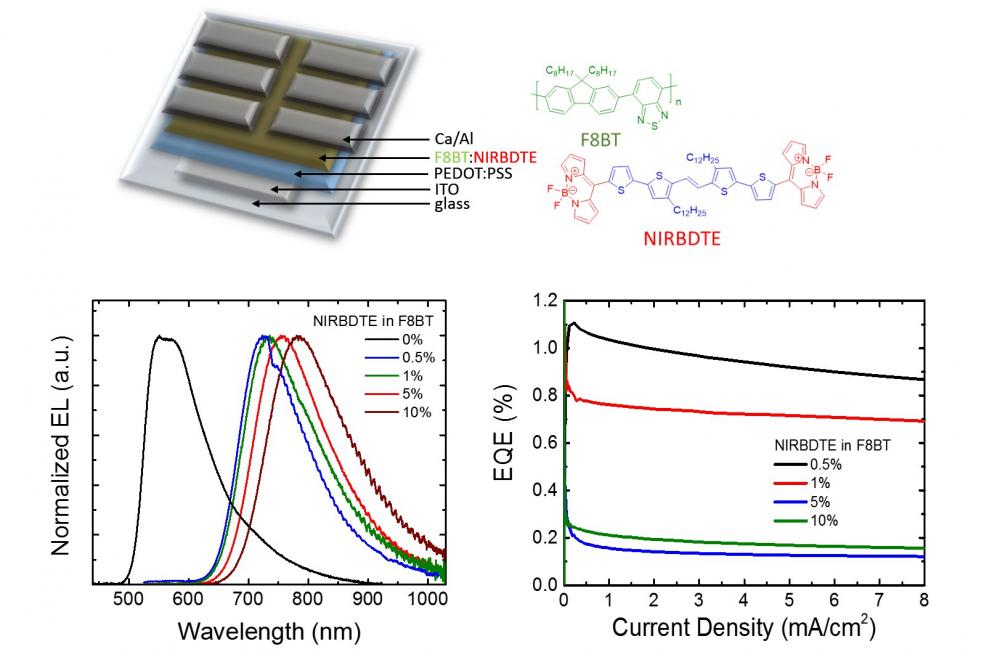
Figure: NIR OLED structures (top), electroluminescence spectra (bottom left) and external quantum efficiency (EQE) versus current density curves (bottom right) of OLEDs, incorporating the blend of the host polyfluorene with different NIRBDTE loading.
Links:
Condensed Matter & Materials Physics (CMMP)
Article in Scientific Reports