A new type of hyperbolic metamaterial has been developed by researchers at King’s College London (KCL) allowing researchers have greater flexibility of manipulating light-matter interactions at the nanoscale.
Hyperbolic Metamaterials are artificial subwavelength-structured media that exhibit unusual optical properties and display indefinite dispersion. They are usually fabricated as metal nanorod assemblies or multilayers on substrates. Researchers in the Department of Physics at KCL have now developed a version of a hyperbolical metamaterial in colloidal form. Published in Laser & Photonics Reviews these hyperbolic metaparticles are dispersed in a solution and may find applications in plasmon‐enhanced spectroscopy, nanolasers, design of nonlinear phenomena, photothermal conversions, and hot‐electron generation.

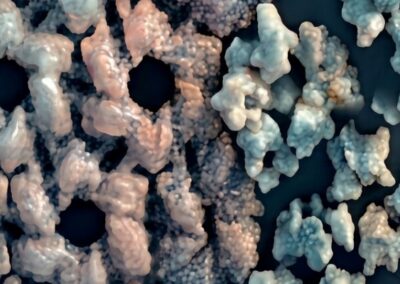
Dr Pan Wang was able to make hyperbolic metaparticles using a wet chemistry method coating nano-objects with alternating silica and gold multishells. The highly anisotropic silica/gold multishells display a hyperbolic dispersion and allow the engineering of refractive index on demand, providing great flexibility in the design of the optical properties of the metaparticles.
Compared with traditional bulk hyperbolic metamaterials, metaparticles in the colloidal form show many interesting advantages such as high flexibility in use (e.g., can be dispersed in a solvent, self-assembled on a surface, or embedded in a bulk matrix) and easy excitation of hyperbolic modes by direct illumination, making them promising for many applications. For example, they can be used as optical antennas for the enhancement of spontaneous emission rate of emitters by directly dispersing them into an active solution or spreading them on an active surface. It is also possible to make metaparticles active by incorporating optical gain, such as dye molecules or quantum dots, directly into the silica shells, which is attractive for developing ultra-small nanolasers. In addition, single metaparticles can work as building blocks for the creation of complex hyperbolic structures via self-assembly, which are difficult to realize using existing fabrication methods.