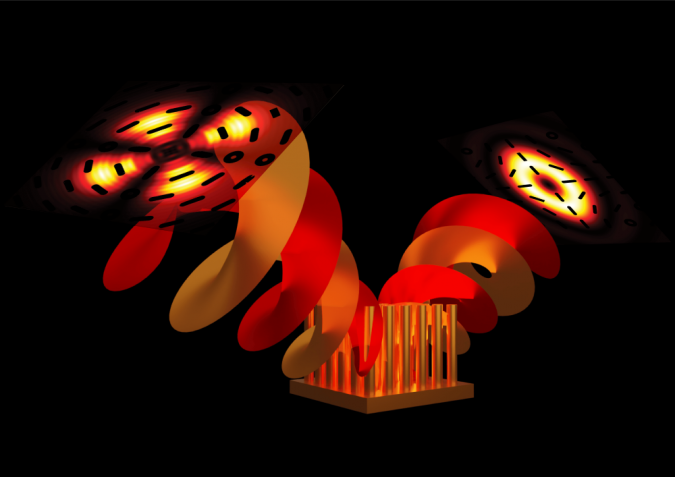

In a recent study published in the IEEE Photonics Journal, Vittorio Aita and Professor Anatoly Zayats from the Photonics and Nanotechnology group at King’s College London explored the use of vector vortex beams in combination with strongly anisotropic metamaterials. Vector vortex beams possess unique characteristics, including complex intensity and polarisation patterns and phase or polarisation singularities, which make them useful in a variety of applications, such as high-resolution imaging, data transmission, nonlinear optics, and quantum technologies.
The researchers examined how these beams propagate through metamaterials that exhibit “epsilon-near-zero” behaviour, which refers to a material that has a very small relative permittivity (a measure of how much a material polarises in response to an electric field). They found that the interaction of the metamaterial with the longitudinal field of the vector beams resulted in a significant modification of the polarisation distribution, with the metamaterial acting as an “azimuthal polariser.” The team also investigated the dependence of this interaction on the local ellipticity of the field, revealing the conversion of “spin angular momentum” to “orbital angular momentum” and “polarisation structure vorticity,” all mediated by the longitudinal field.
The results of this study suggest that anisotropic metamaterials may have great potential as a platform for manipulating the polarisation properties and spin-orbit coupling of vector vortex beams, opening up new possibilities for their use in various fields.
Enhancement of Optical Spin-Orbit Coupling in Anisotropic ENZ Metamaterials is published in IEEE Photonics Journal.
Image credit: Vittorio Aita – King’s College London.