
Our people

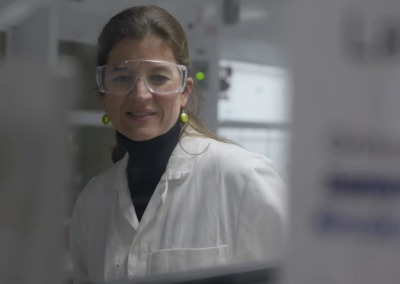
Zena Hadjivasiliou

Zena obtained a BA in Mathematics at Magdalene College, University of Cambridge, in 2004, and an MSc in Statistics at Stanford University in 2007. She went on to do an MRes and PhD in Mathematical Biology at UCL, studying the evolution of sexual differentiation.

In 2014 she received an EPSRC Doctoral Prize Fellowship to study the role of cell-cell signaling in development and evolution. During this time she worked closely with experimental collaborators to study the role of Notch signaling in spatiotemporal pattern formation in the Drosophila notum and zebrafish spinal cord.

She then moved at the University of Geneva and the Max Planck Institute for the Physics of Complex Systems in Dresden as an HFSP Long Term Fellow. As a postdoctoral fellow  Zena studied morphogen gradient formation, and the machineries that allow morphogen gradients to scale to size during developmental growth.

Her group studies growth and patterning in development and evolution through the lens of physics and mathematics. Zena holds a joint appointment at the Department of Physics and Astronomy at the University College London.

Hadjivasiliou Lab

Institution: UCL

Office/location: 709

Email: [email protected]

Related news

Poles of bacteria imaged in fine detail for the first time

The study, published in the journal Nature Communications, used a new technique to keep live bacteria in place so the cells could be imaged …Find out more

From proof-of-concept to scale-up: Metamaterials at Royce at Imperial

From proof-of-concept to scale-up: two days exploring the future of metamaterials in the UK. On 19–20 October, Royce at Imperial hosted the …Find out more

LCN Researcher named 2026 Blavatnik Awards Laureate

Professor Maxie Roessler of Imperial College London’s Department of Chemistry has been named a Laureate of the 2026 Blavatnik Awards for You…Find out more

Equipment & Facilities

EDUCATION

Training

Loading...
Privacy Overview

This website uses cookies so that we can provide you with the best user experience possible. Cookie information is stored in your browser and performs functions such as recognising you when you return to our website and helping our team to understand which sections of the website you find most interesting and useful.