
News

The makings of a Hund’s metal

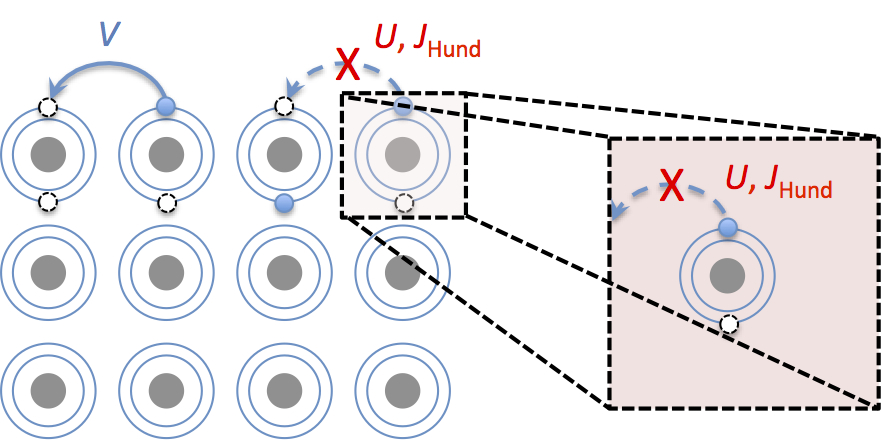
In atomic physics, Hund’s rules refers to a set of guidelines which are used to determine the term symbol that corresponds to the ground state of a multi-electron atom.  The concept of a ‘Hund’s metal’ has arisen from the realization that the interactions that drive Hund’s rules for filling the orbitals of isolated atoms with electrons can also dramatically affect the hopping of electrons between atoms in solids, the motion of which is correlated and may support both high-temperature superconductivity and magnetism.

LCN researcher Dr. Cyrus Hirjibehedin has written a News & Views article providing an overview of this realization of the atomic-scale building block of a Hund’s metal.  This follows a publication by Alexander Khajetoorians and colleagues in the same issue that reports that a single iron atom on a platinum surface forms the basic building block of a ‘Hund’s impurity’.

Magnetic atoms: The makings of a Hund’s metal’ can be accessed online in Nature Nanotechnology News and Views.

More news

LCN Researcher named 2026 Blavatnik Awards Laureate

LCN Researcher named 2026 Blavatnik Awards Laureate

Professor Maxie Roessler of Imperial College London’s Department of Chemistry has been named a Laureate of the 2026 Blavatnik Awards ... Find out more

LCN co-director receives 2026 SPIE Directors’ Award

LCN co-director receives 2026 SPIE Directors’ Award

LCN co-director Professor Anatoly Zayats has been awarded the 2026 SPIE Directors’ Award.  SPIE, the International Society for Optics ... Find out more

LCN 20th Anniversary – Programme of Events

LCN 20th Anniversary – Programme of Events

The LCN is delighted to share its programme of events for the LCN’s 20th anniversary! To celebrate this milestone, the LCN is ... Find out more

Equipment & Facilities

EDUCATION

Training

Loading...
Privacy Overview

This website uses cookies so that we can provide you with the best user experience possible. Cookie information is stored in your browser and performs functions such as recognising you when you return to our website and helping our team to understand which sections of the website you find most interesting and useful.