
The cover of the current issue of ACS Synthetic Biology highlights the work of a research team from UCL, the LCN and NPL to engineer a programmable inside-out “virus”. This everted “virus” is designed to deliver functional proteins into live cells.
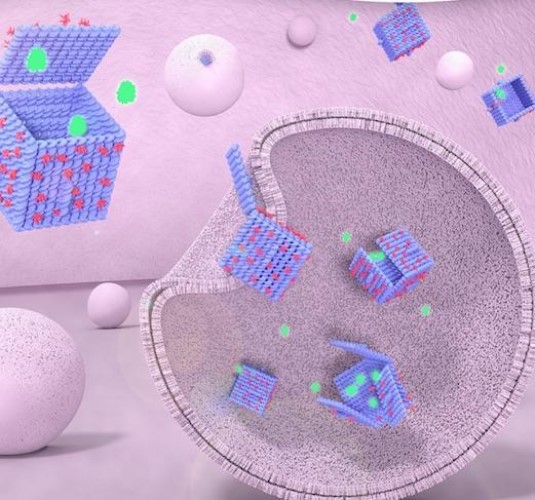
The synthetic virus is formed of a DNA origami shell, decorated with HIV-Tat protein transduction domains which promote its uptake into live cells. The DNA origami shell is box-like in structure, incorporating a lid with a pH switchable locking mechanism. As the lid opens in response to intracellular pH changes, the encapsulated proteins are released into the cell.
To determine the topology of the nanoscale DNA origami virus shell, Dr Alice Pyne, a research fellow at the LCN, utilised high resolution atomic force microscopy (AFM) to determine the dimensions of the DNA origami shell in a native-like environment.

Image: DNA origami viruses inside endosomes. Upon escaping endosomes, the viruses get inside the cell and release green fluorescent protein (GFP). The background of the Figure denotes an intracellular environment, balls indicate endosomes, green particles show GFP.
The work was kindly funded by the Engineering and Physical Sciences Research Council (EPSRC) and the UK’s Department for Business, Energy and Industrial Strategy.
Research article in ACS Synthetic Biology