
A paper published in Scientific Reports by LCN researchers based at both UCL and Imperial College, presents the first thorough characterisation of a room temperature, zero-field MASER (a type of laser emitting microwaves); a system that was only discovered in 2012.
MASERs were invented prior to LASERs but whereas their ubiquitous cousins are used everywhere from the barcode scanner in a shop to eye surgery, due to their complexity, MASERs have found only limited applications, most notably for deep space communication. Indeed, solid-state masers employing crystals such as ruby typically require large magnetic fields and cryogenic cooling (to about -269 °C) to operate.
The system studied here employs the properties of photo-excited molecules to achieve microwave amplification, ultimately converting visible photons into microwave photons. Notably, it operates at room temperature and with no need of bulky magnets.
Dr Enrico Salvadori, paper lead author, said “Room-temperature MASERs have the potential to revolutionise modern science, from magnetic spectroscopy to deep space communications, owing to their exceptional performance as low-noise amplifiers or frequency sources and to their simple construction. The results published in Scientific Reports provide a straightforward theoretical framework to extract important physical parameters form the MASER emission profile”.
Professor Chris Kay, also corresponding author, added: “In this original contribution, we decided to employ extremely short laser pulses (of the order of a billionth of a second long) to understand how the visible photons are converted into microwave photons and amplified. We strongly believe this research to be of relevance to not only those concerned with materials photophysics, microwave engineering, magnetic spectroscopy and device development, but also to the general public as it provides an original insight into a novel and exciting research field”.
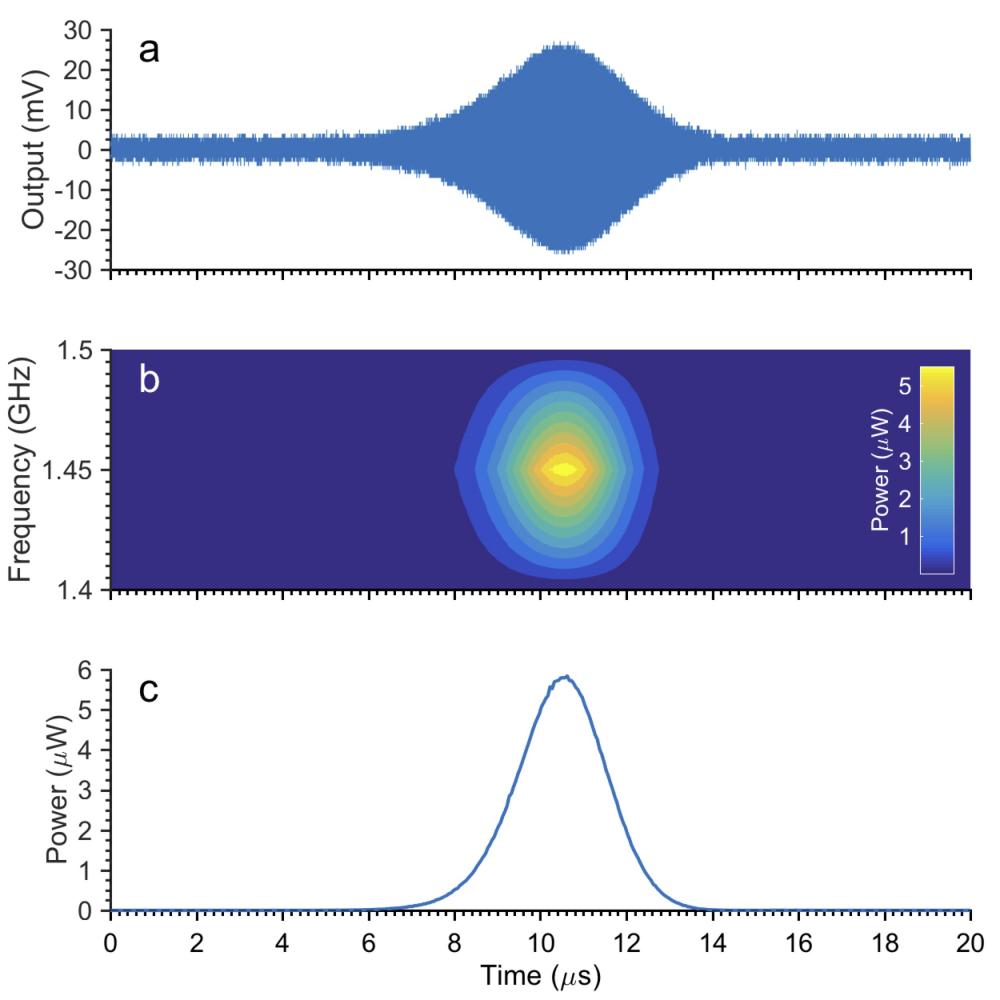
Image: Response of the MASER to a nanosecond laser pulse. (a) Microwave output of the MASER directly detected by an oscilloscope. (b) Fourier transform of the signal in (a) shows the principal frequency of the output is centred at 1.45 GHz. (c) A slice through the surface in (b) at 1.45 GHz, showing the maximum output occurs at 11 μs after the laser pulse.
Related links:
UCL Mathematical & Physical Sciences