
Dr Iain Dunlop’s uses methods from nanotechnology and surface chemistry to address questions in cell biology. In vivo, cells determine their behaviour largely by reacting to their environments; in particular, they respond to specific signals that are located on surfaces that they come into contact with. Such signals are hugely important in ensuring each cell plays its role within multicellular organisms. However, because biological surfaces are complex, it can be difficult to know exactly which features are significant. This problem can be addressed by making artificial surfaces that imitate aspects of in vivo surfaces, varying the properties of these artificial surfaces, and observing their effects on the behaviour of cells brought into contact with them. Through this process, the mechanisms of cell signalling can be understood.
Our people

Iain E. Dunlop

Related news

LCN Researcher named 2026 Blavatnik Awards Laureate
Professor Maxie Roessler of Imperial College London’s Department of Chemistry has been named a Laureate of the 2026 Blavatnik Awards for You…Find out more
LCN 20th Anniversary – Programme of Events
The LCN is delighted to share its programme of events for the LCN’s 20th anniversary! To celebrate this milestone, the LCN is participating …Find out more
LCN Academic-Industry Meeting Day 2025
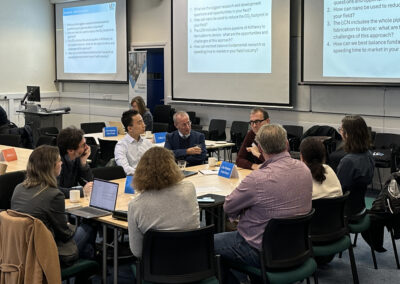
On December 17th, 2025, the LCN hosted an Academic-Industry Meeting Day at Imperial College’s Royal School of Mines. Over 50 attendees, inc…Find out more