
LCN researchers from the Department of Physics at King’s College London have pioneered a new way of linking tiny levitated microparticles using a virtual partner, opening up exciting possibilities for precision measurement and next-generation sensing technologies.
Levitated particles are microscopic objects suspended in vacuum by laser light or electrical fields. They behave like high-quality mechanical oscillators with exceptionally low interaction with their surroundings – like a bell which rings for a long time after being struck. This pure oscillation makes levitated particles powerful sensors of extremely small forces and for studying fundamental physics.
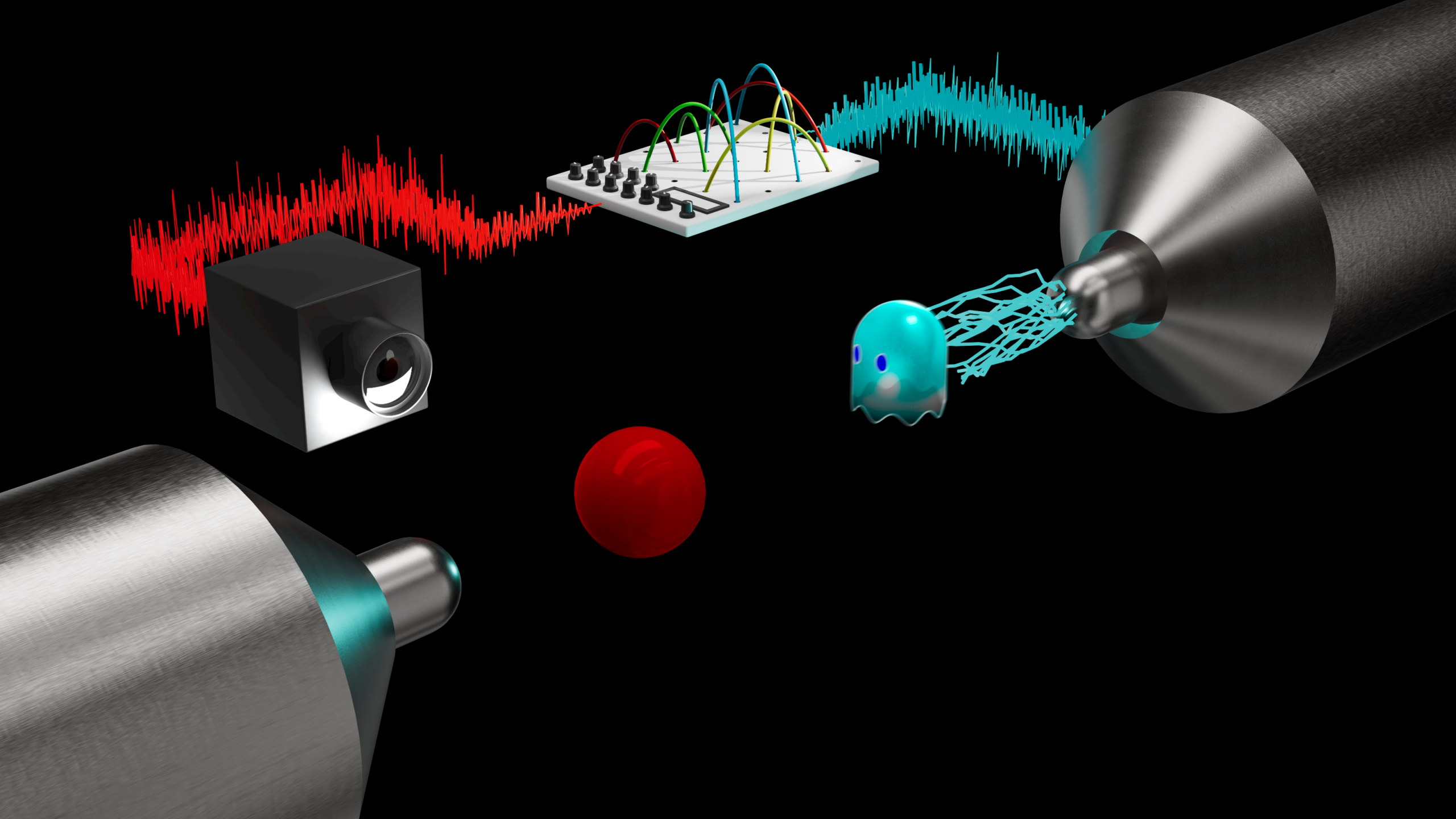
In a study published in Photonics, the researchers report the first demonstration of a semi-virtual coupling between a real levitated oscillator and a simulated ‘ghost’ particle generated on an analogue computer. By engineering an interaction between the real and virtual systems, the team were able to make the levitated particle exhibit coupled-oscillator dynamics, behaviour typically seen only when two physical oscillators interact directly.
Instead of using a second physical particle, the virtual oscillator can be controlled and tuned in real time. This provides unprecedented flexibility in tailoring the interaction and offers a new method for measurement-based control of levitated systems, with potential applications in high-precision control and physical simulation.
“Levitated mechanical systems are already being developed for force sensing, inertial measurement and tests of quantum physics. The ability to engineer ghost-like interactions is a spooky new tool in our particle control toolbox. The semi-virtual coupled oscillators could enable new strategies for cooling mechanical motion towards its quantum ground state.” – Professor James Millen, King’s College London
The research lays the theoretical and experimental foundations for more sophisticated levitated architectures that combine real and simulated elements, a frontier that could accelerate the development of high-precision measurement and quantum-inspired technologies.
Links: