
A collaboration between LCN researchers and the University of Duissburg-Essen has found a way to strengthen quantum networks by levitating key components, whilst simultaneously exploring the boundaries of quantum mechanics.
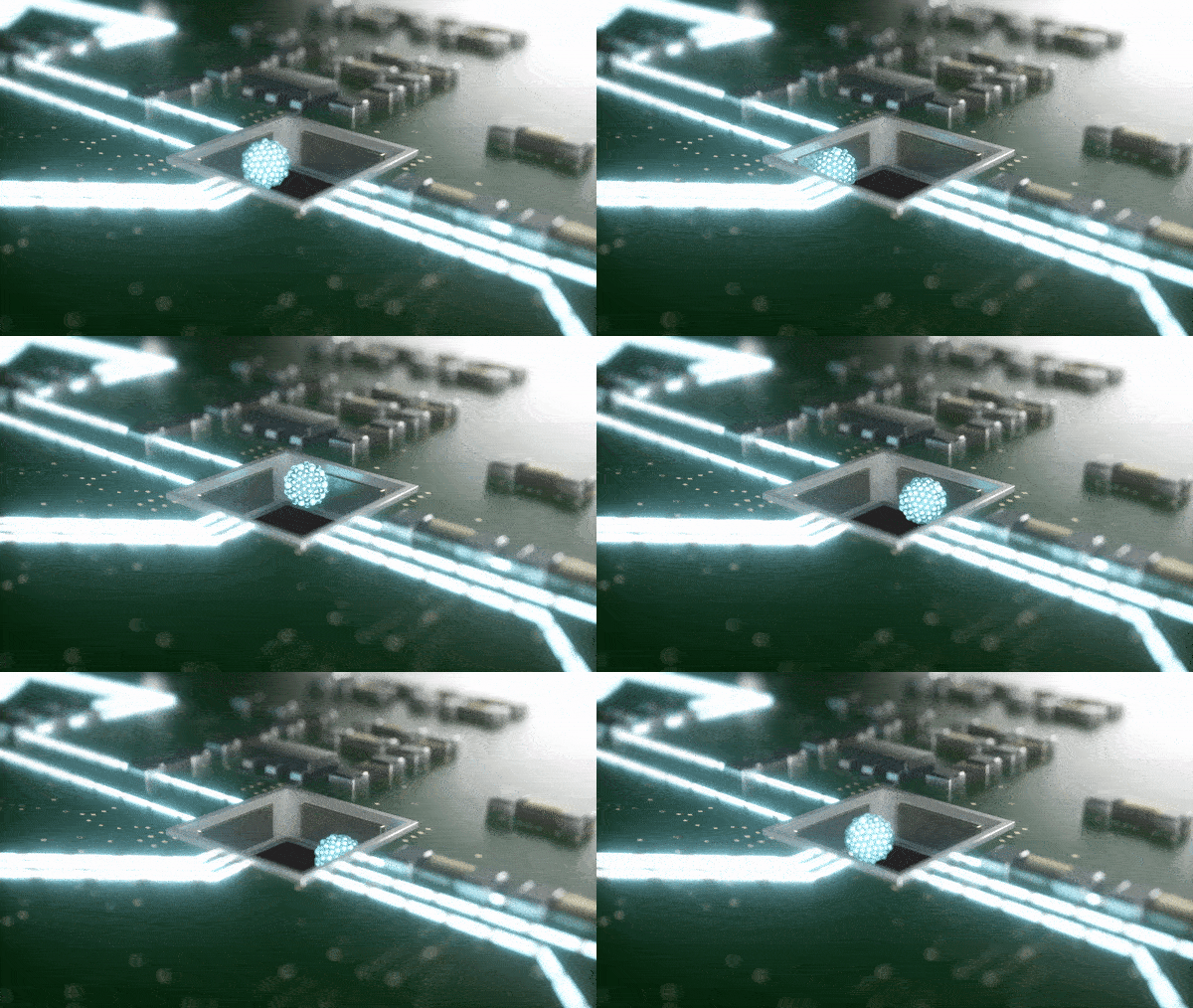
Electro microparticles – Dr James Millen
Do you believe in quantum physics? Quantum theory is the unchallenged description of the microscopic realm, yet seemingly has little impact on the world around us. While it is possible for photons or electrons to “be in two places at once”, known as quantum superposition, the chair you’re sitting on displays a stubborn refusal to play quantum ball.
There are good reasons why it’s hard to make big objects behave in a quantum way; quantum mechanics requires exquisite isolation to manifest its stranger behaviours. The bigger something is, the harder it is to isolate. In his lab at King’s, Dr. James Millen uses light and electrical fields to levitate microparticles in a vacuum, achieving the required isolation from the environment. Although they sound tiny, microparticles are more than a thousand times larger than the current largest quantum objects, and much larger than components used in modern electronics.
We do exploit quantum physics in technology, with companies like Google and IBM building quantum computers using tiny electrical quantum systems called qubits. The lead author on this collaborative project, Lukas Martinetz from the University of Duisburg-Essen, found a way to connect qubits and levitated microparticles, sharing their quantum behaviour with the otherwise non-quantum particles.
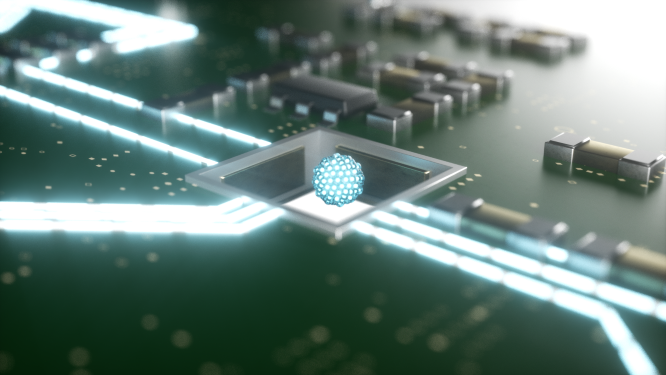
By working with charged microparticles, their motion can be detected and effected by nearby electrical circuitry. The team considers interfacing a charge quibit, meaning that the voltage in the circuit can be in a quantum superposition. This voltage will exert a force on the levitated microparticle, pushing it into a superposition of positions. By introducing the levitated object, the utility of the quantum circuit is greatly enhanced. Delicate quantum information can be stored in the motion of the particle, and shared between other distant qubits, building a robust quantum network. This will boost the usefulness of quantum computers, and help us build a quantum internet.
Observing a micro-scale object in a quantum superposition would extend the reach of quantum theory into the world around us. In the future, this could be used to understand the interaction between quantum physics and gravity, one of today’s greatest scientific challenges.
Quantum electromechanics with levitated nanoparticles is published in NPJ Quantum Information
This work is supported by EPSRC New Investigator Award EP/S004777/1 and ERC Starting Grant 803277.
High res video – https://youtu.be/GpHGkQvsKPM