
A recent study published in Communications Chemistry has uncovered new insights into the process of lipid peroxidation and its effects on cell signalling and disease. Lipid peroxidation is a process in which the structure and mechanical behaviour of cell membranes is altered, and is currently being explored as a potential treatment for cancer through photodynamic therapy.
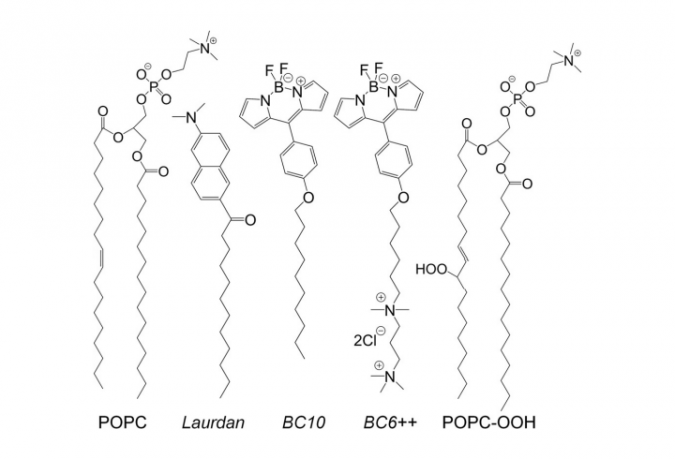
LCN researchers at Imperial and King’s, alongside researchers from Lithuania, France and Spain, employed a combination of advanced microscopy techniques, including viscosity-sensitive fluorophores, X-ray diffraction, and molecular simulations to directly measure the structural and viscoelastic properties of lipid bilayers during peroxidation. The team also used molecular modelling to correlate their experimental results with the underlying molecular mechanisms.
‘The unique advantage of our approach was to combine several experimental methods with molecular simulations to directly visualise domain formation within peroxidised membranes. This suite of methods is very powerful and can lead to further discoveries in lipid biophysics‘ Marina Kuimova
The study found that peroxidation of the membranes leads to an increase in microviscosity and a decrease in the bending rigidity, which is contrary to the trend observed with non-oxidized lipids. Additionally, the team observed the presence of regions of different local order within the oxidized membranes using fluorescence lifetime imaging microscopy and molecular dynamics simulations. The researchers propose that the stronger lipid-lipid interactions promoted by peroxidation lead to an increase in lateral heterogeneity within the bilayer, resulting in the formation of lipid clusters of higher order. These findings have important implications for our understanding of the effects of lipid peroxidation on cell signalling and disease, and for the development of new cancer therapies.
‘Our results provide new insights into how lipid peroxidation affects the interactions between lipid species and in turn what effects it then has on cell membranes. In the next steps we will investigate whether we can predict the structural and mechanical properties of cell membranes under different kinds of oxidative stress.’ Chris Lorenz
You can view the article Directly imaging emergence of phase separation in peroxidized lipid membranes on the Communications Chemistry website.
Image adapted https://doi.org/10.1038/s42004-022-00809-x – (CC BY 4.0)