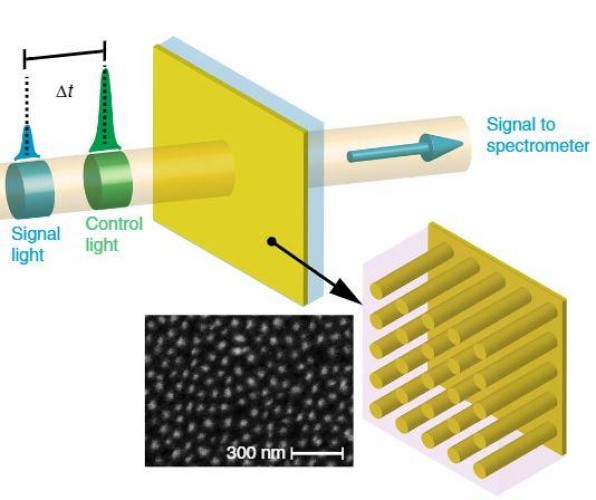

LCN researchers at King’s College London have discovered how to control light at ultrafast timescales by designing the distribution of energy of electrons in nanostructures. These metallic nanostructures are manmade materials that can have interesting optical properties, not found in naturally occurring materials. It has been found that these nanostructures can have regions of very high light-matter interaction, with the study of this interaction known as the field of plasmonics. By using intense pulses of laser light, electrons in these regions absorb larger amounts of energy, changing the electrons’ characteristic temperature. When the electron temperature increases, the optical properties of the material change. They can become more opaque or transparent at certain wavelengths in the spectrum of light. By altering the distribution of this electron temperature within the nanostructure, the researchers found a way to control the speed at which the optical properties of the nanostructure change. Using this they demonstrated control over the intensity of light passing through the nanostructure on a sub-300 fs time scale.
One of the researchers Luke Nicholls said, “The ability to change the dynamic optical response of nanostructures by proper design of electron temperature distributions could have wide ranging applications for technology in telecommunications and chemistry.” The switching of optical properties at faster speeds in data processing and communication, would help with the ever-growing demand on access to data, which is straining current infrastructure. Furthermore, the ability to generate hot electrons in specific locations within a nanostructure could provide added functionality in photo-assisted catalysis and nonlinear optics.
Link to research paper: Designer photonic dynamics by using non-uniform electron temperature distribution for on-demand all-optical switching times